
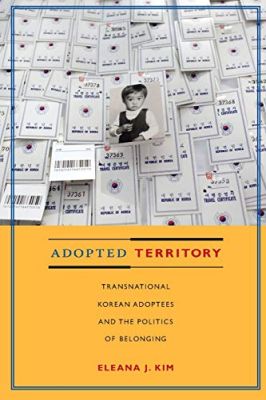
Adopted Territory: Transnational Korean Adoptees and the Politics of Belonging
by Eleana J. Kim
Since the end of the Korean War, an estimated 200,000 children from South Korea have been adopted into white families in North America, Europe, and Australia. While these transnational adoptions were initiated as an emergency measure to find homes for mixed-race children born in the aftermath of the war, the practice grew exponentially from the 1960s through the 1980s. At the height of South Korea’s “economic miracle,” adoption became an institutionalized way of dealing with poor and illegitimate children. Most of the adoptees were raised with little exposure to Koreans or other Korean adoptees, but as adults, through global flows of communication, media, and travel, they have come into increasing contact with each other, Korean culture, and the South Korean state. Since the 1990s, as Korean children have continued to leave to be adopted in the West, a growing number of adult adoptees have been returning to Korea to seek their cultural and biological origins. In this fascinating ethnography, Eleana J. Kim examines the history of Korean adoption, the emergence of a distinctive adoptee collective identity, and adoptee returns to Korea in relation to South Korean modernity and globalization. Kim draws on interviews with adult adoptees, social workers, NGO volunteers, adoptee activists, scholars, and journalists in the U.S., Europe, and South Korea, as well as on observations at international adoptee conferences, regional organization meetings, and government-sponsored motherland tours.
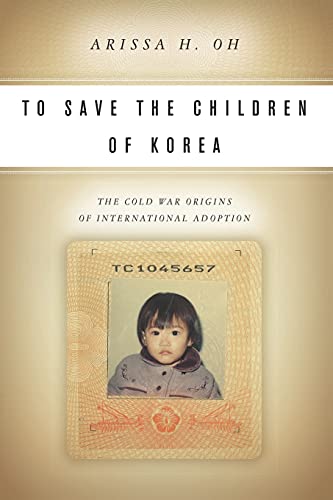
To Save the Children of Korea: The Cold War Origins of International Adoption
by Arissa H. Oh
To Save the Children of Korea is the first book about the origins and history of international adoption. Although it has become a commonplace practice in the United States, we know very little about how or why it began, or how or why it developed into the practice that we see today.
Arissa Oh argues that international adoption began in the aftermath of the Korean War. First established as an emergency measure through which to evacuate mixed-race “GI babies,” it became a mechanism through which the Korean government exported its unwanted children: the poor, the disabled, or those lacking Korean fathers. Focusing on the legal, social, and political systems at work, this book shows how the growth of Korean adoption from the 1950s to the 1980s occurred within the context of the neocolonial U.S.-Korea relationship, and was facilitated by crucial congruencies in American and Korean racial thought, government policies, and nationalisms. It also argues that the international adoption industry played an important but unappreciated part in the so-called Korean “economic miracle.”
Korean adoption served as a kind of template as international adoption began, in the late 1960s, to expand to new sending and receiving countries. Ultimately, Oh demonstrates that although Korea was not the first place that Americans adopted from internationally, it was the place where organized, systematic international adoption was born.

The “Unknown” Culture Club: Korean Adoptees, Then and Now
by Janine Myung Ja
This collection, compiled by Korean adoptees, serves as a tribute to transracially adopted people sent all over the world. It has been hailed to be the first book to give Korean adoptees the opportunity to speak freely since the pioneering of intercountry adoption after the Korean War. If you were adopted, you are not alone. These stories validate the experiences of all those who have been ridiculed or outright abused but have found the will to survive, thrive, and share their tale. Adopted people all over the world are reclaiming the right to truth and access to birth documents. This book is a living testament on why previous “orphans” do not endorse the profitable Evangelical Orphan Movement. Those who work in the human rights field, whistleblowers, or adopted, will see the value of this book. After years of forced “positivity” led by the profiteers, it is time to be real. These are real stories from individuals no longer serving the adoption pioneers’ fanciful wishes and advertising campaigns. Read this book before you pay adoption agency fees. These courageous narratives could save you tens of thousands of dollars or prevent you from obtaining a child unethically. Be the first to read these narratives and join the ever-expanding Adoption Truth and Transparency Worldwide Network. It’s never too late to walk in awareness!
 Korean Adoptee Resource Hub